What governments put out to tender in software, IT and marketing: November 2026 in numbers
Public buyers in the UK, the US, Canada, Ireland and the rest of Europe publish their tenders as open data. I counted the ones for digital work published between 2 and 16 November 2026: software, IT and cyber, websites, data, marketing, video, translation and e-learning. There were 312 of them.
Here is what they ask for, who buys, how long you get to answer and how often anyone tells you the budget.
The short version
- 312 notices in two weeks. The split is US 109, UK 81, the rest of Europe 66, Ireland 29 and Canada 27.
- Software is half of everything (153 notices). Next come IT and cyber (79), marketing and creative (52), and data and AI (32).
- The US gives you the least time. The median is 14 days from publication to deadline. In the UK it is 27 days, in Ireland 32.
- Budgets are a European habit. 83% of Irish and 64% of UK notices state a value. None of the US or Canadian notices in these feeds do.
- Half of the US notices are not bids yet. 52 of the 109 are "Sources Sought": market research before the real solicitation.
What they want, country by country

- US. The US federal list is the largest and the most technical. IT and cyber (46) and software (45) make up almost all of it, and 57 of the 109 notices come from defence: the Air Force (21), the Navy (15), the Army, DISA and the Defense Logistics Agency. Veterans Affairs adds 14 more.
- UK. The mix is broader. Software leads (39), but marketing and creative work is second with 23 notices, more than in any other country. The buyers are spread thin: the busiest, NHS Grampian, published five. The rest are councils, universities, colleges, museums and transport bodies, one or two notices each.
- Rest of Europe. These are the English-language notices on TED, the EU's tender journal. They are mostly Norway (36 of 66), then Germany, Belgium and Denmark. Software dominates, often system development frameworks run by municipalities and state companies.
- Canada. At the federal level the main buyer is Public Services and Procurement Canada (7 notices), followed by National Defence (4).
- Ireland. The list is small but varied: health (HSE), the food board, universities and county councils.
How long you get
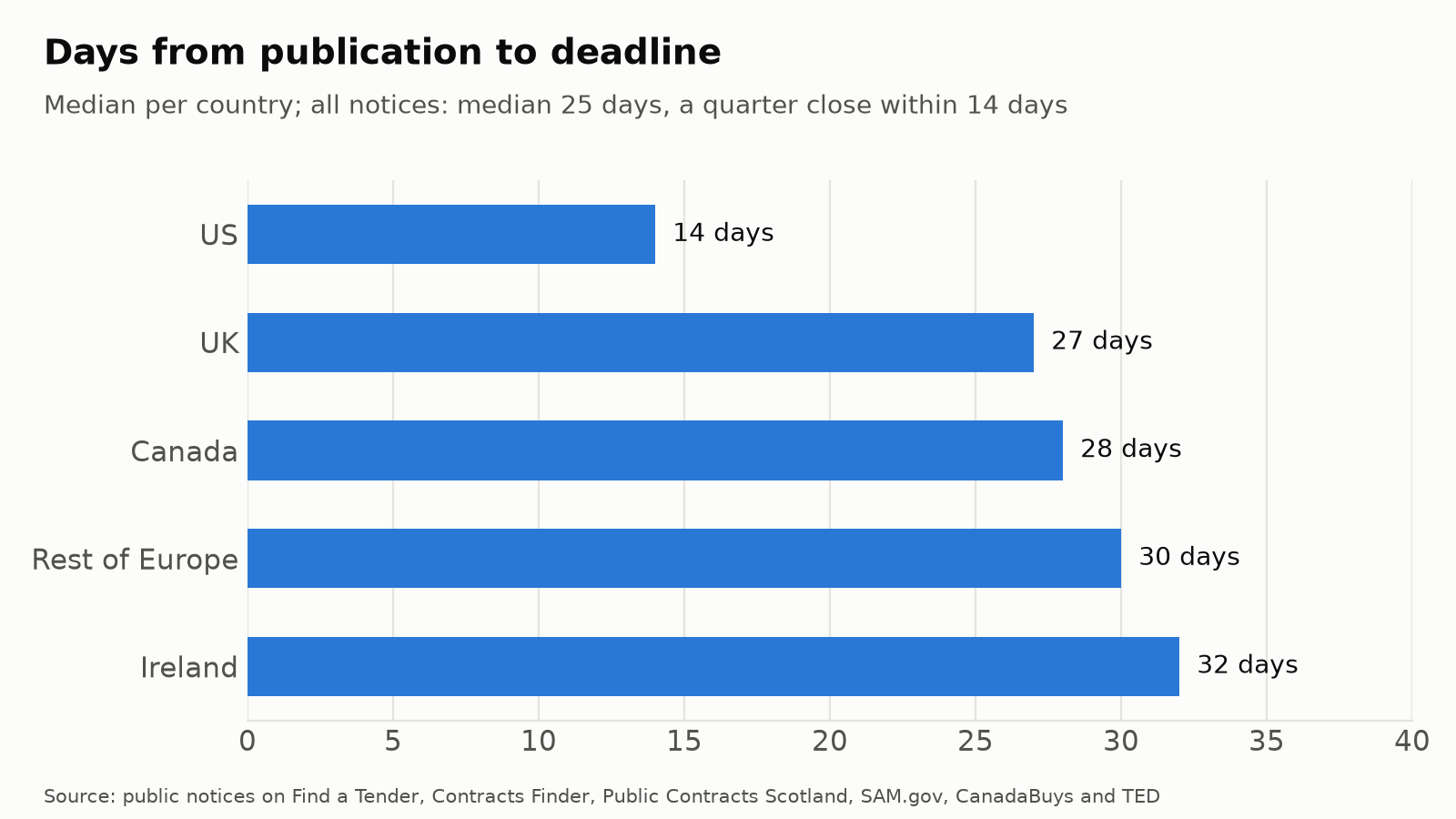
Across all notices with a deadline, the median gap between publication and deadline is 25 days, and a quarter close within 14 days.
The US is the outlier at a median of 14 days. A combined synopsis or a solicitation posted on a Monday is often due two weeks later. If you check SAM.gov once a week, you lose half of every response window.
European notices sit close to the EU's minimum periods, so about 30 days is typical there.
The US "Sources Sought" notices deserve a separate mention. They are requests for information, not bids. Answering one costs a few pages describing your capability. In return, the agency knows you exist before it writes the requirement, and it learns whether enough small businesses are interested to reserve the contract for them. In this sample, 20 of the 109 US notices were already set aside for small businesses.
How often you see a budget
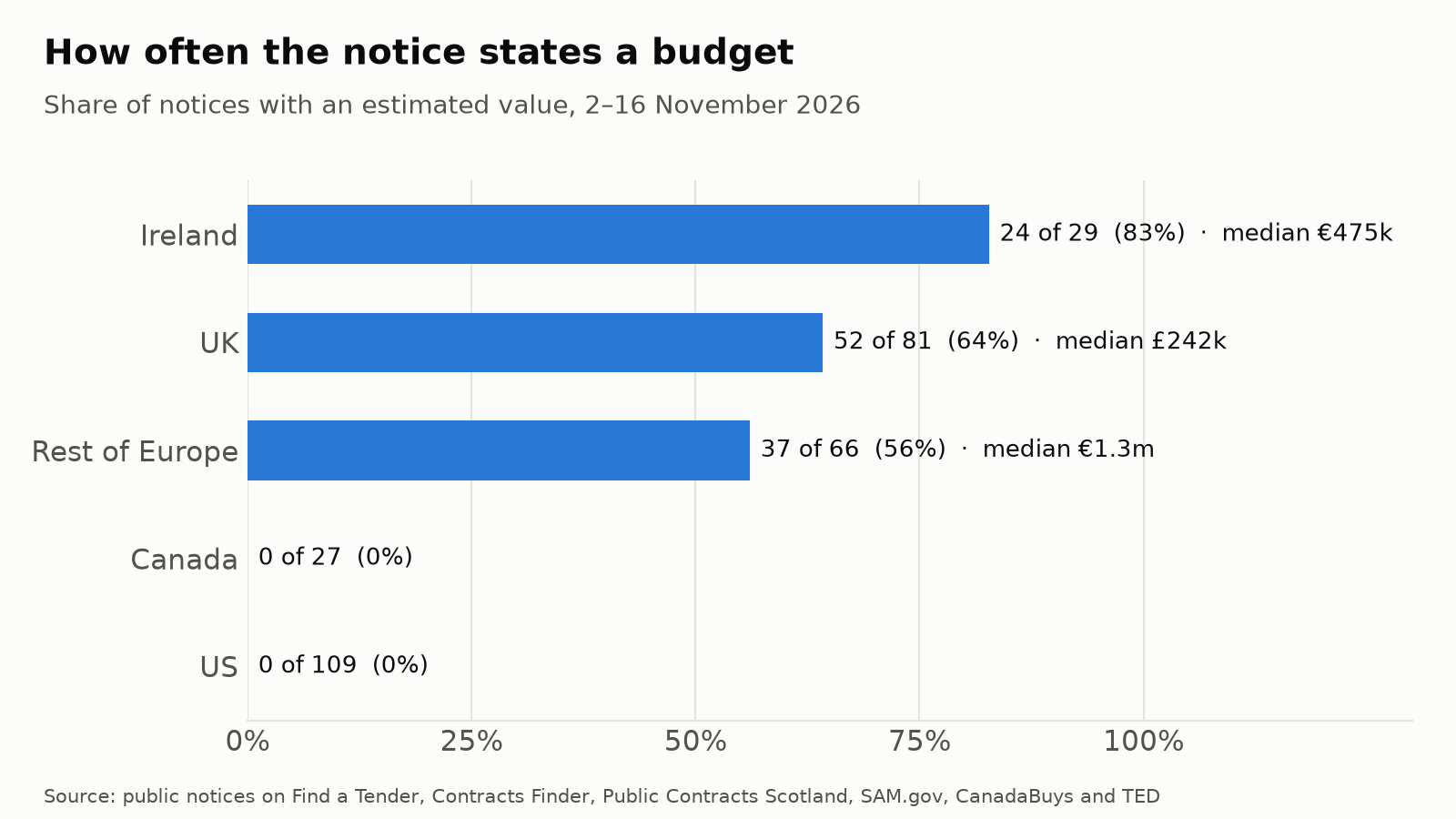
| Notices with a value | Median value | |
|---|---|---|
| Ireland | 24 of 29 | €475k |
| UK | 52 of 81 | £242k (half fall between £140k and £3m) |
| Rest of Europe | 37 of 66 | €1.3m for notices in euros; NOK 19m for the Norwegian ones |
| US | 0 of 109 | — |
| Canada | 0 of 27 | — |
A stated value is an estimate, and for frameworks it is a ceiling for all suppliers over several years, not one contract. Still, it is the quickest filter for whether a notice is your size. In the US and Canada you have to read the statement of work and guess.
The largest values this fortnight:
- €6bn: EuroHPC's call to select consortia for AI gigafactories (Luxembourg).
- £350m: a network services contract for the Mayor's Office for Policing and Crime in London.
- £200m: an ICT framework from Virano.
- NOK 1.41bn: a development services framework from Entur, Norway's public transport ticketing company.
- DKK 900m: an IT infrastructure outsourcing tender from DSB, the Danish railway.
- £75m: customer information software for Northern Trains.
- €27.2m: VMware licences for ESB, the Irish electricity company.
The small ones
The big frameworks get the headlines, but most notices are sized for a small agency or a freelancer with a company behind them. A few from the same two weeks:
- Marketing, advertising and media buying for Wirral Metropolitan College, £92k, due 30 November.
- A town marketing and business support consultant for Market Drayton Town Council, due 27 November.
- An IT disaster recovery plan for the Cairngorms National Park Authority, due 4 December.
- An animation project for Louth County Council, €25k, due 23 November.
- Videography services framework for Munster Technological University, €600k over its term, due 18 December.
- Running and developing the websites of IMDi, the Norwegian directorate for integration and diversity, NOK 20m, due 1 December.
- A dynamic purchasing system for web design at University College Dublin, €1.5m. A dynamic purchasing system stays open for new suppliers, so it is worth joining even late.
How the numbers were made
- Sources. The notices come from Find a Tender, Contracts Finder and Public Contracts Scotland (UK), SAM.gov Contract Opportunities (US federal), CanadaBuys (Canada federal) and TED (Ireland and the rest of Europe). All of them are open data, with no keys needed.
- What counts as digital work. A notice counts if the buyer's main classification code (CPV, NAICS/PSC or UNSPSC) or a keyword in its title says so. Titles about buildings, vehicles, medical equipment, telephony and the like are filtered out.
- US and Canada. For those two countries the feeds keep only notices that are still open, so the counts are notices published 2–16 November and still open on 17 November.
- Values are as stated by the buyer, in the buyer's currency, with no conversion.
The daily list these numbers come from, with filters by country and category and RSS feeds, is at brieflist.pages.dev. I will repeat the count for the whole of November in early December.
Follow these tenders as they appear: Brieflist lists every open public-sector opportunity for digital work, updated daily. Pro e-mails new matches each morning, with a 7-day free trial. See also live statistics and who won recent contracts.